Saturday, 19 April 2025

GENGHIS TRUMP?


It can’t have escaped some of my readers that customary Left-wing analyses have become a rather poor fit with our current predicament, namely the ongoing disruption caused by Donald Trump’s 2nd term as US President. We’re accustomed, even those of us who aren’t dogmatic Marxists, to think about politics as having something to do with class. There’s the class of people who have to work for a living, and the class of people who own factories, studios, etc etc who employ them. In the middle there are small businesses, freelancers, artists etc etc. The assumption has been that the class who own capital knows how to stick together and protect their interests better than everyone else, hence the inequality and other ills that beset us.

Trump poses a challenge to that assumption. He captured the US Republican Party by appearing to be one of them, a representative of the ruling capitalist class who would advance their interests by deregulation and tax cuts. But what if that’s not who he is? It’s starting to look as though he may be a throwback to something pre-capitalist, a neo-feudal dynast after the model of Mogul Emperors and Chinese Warlords, whose only loyalty is to his own power and wealth and that of his immediate family (not even his disposable entourage). 


What prompts this thought is that his reckless tariff war is beginning to look very dangerous to the interests of the US industrial capitalist class, and some Republicans are already starting to realise this. Perhaps those promised tax cuts might get reduced by a heap of pseudo-populist payouts to that dispossessed, disgruntled proletarian MAGA base that elected him – attempting to forge stronger links between a new peasantry and their beneficent overlord. And should the demolition of the Silicon Valley oligarchs prove another side-effect, so much the better as he sees them as competitors, not friends.


If there’s any truth at all in this speculation, then expect some very exciting fireworks in the near future as the oligos spend all the money in the world trying to dislodge the man who ostensibly controls the armed forces and intelligence services…. 


Saturday, 15 February 2025

WIDENING GYRE


The world appears too crazy at the moment to step back far enough (or for long enough) and say anything joined-up -- so I'll fudge it by stringing together a bunch of thoughts I've posted recently on social media as they occurred to me. Re-arrange them to make a well-known phrase or political outlook....

ON READING RICHARD COCKETT'S 'VIENNA'

History shows repeatedly that as capitalism reaches a terminal crisis the choice  is between Fascism and Social Democracy, but that the far Left and far Right always collaborate to prevent Social Democracy. Weimar, Red Vienna, today's China, the USA?

GIT ALONG LITTLE DOGE

For 80+ years the right-wing of the US Republican Party has wanted to roll-back Roosevelt's New Deal. For the whole of the 21st century they've been promoting 'culture wars' to roll back the social changes wrought by the '60s counterculture. Since Trump's first presidency they've promised to weed out the 'deep state' of federal security agencies. Now they look to be within sight of winning the big coconut, by reversing the result of the Civil War and restoring rule by the states...

DOUBLE ACT

When some future historian, (animal or digital, of whatever species, from whatever nation or planet impossible to guess), sets out to write 'The Fall Of The US Empire', 2025 will be labelled the era of the 'Dual Monarchy'

HISTORY UPDATE

OK, please have your history book ready for the following update. Many thought that the Cold War ended in a Western victory in 1989 when the Berlin Wall came down. This must now be revised to read, the Cold War ended in Russian victory in February 2025 with the activation of the assets they've installed in the US White House.


Thursday, 19 December 2024

HELL OF A YEAR

2024 has been a Hell Of A Year, almost literally, so that will have to be my excuse for neglecting this blog for a while. However I will post these two significant pieces I did for different platforms as a stop-gap. 

A review of Susan Neiman for Political Quarterly:
https://substack.com/@politicalquarterly/note/c-7933333

And a podcast of a trip to Prague for The Scotch Malt Whisky Society:
https://unfiltered.smws.com/unfiltered-01-2024/smws-adventures-prague

Whisky Talk podcast:
https://whiskytalk.fireside.fm/66

Saturday, 7 December 2024

HEBE-JEEBIES

I recently finished watching all 18 episodes of Paul Cooper’s excellent podcast series ‘Fall Of Civilisations’ (available free on several platforms including YouTube). As well as provoking a new-found admiration for the Nabataean civilisation and revulsion against the Romans, it’s made me think about the way our own civilisation is going to collapse, which is not an easy think: there too many candidates for the coup de grace - climate change, war (nuke or plain), crypto-economic ruin, pandemic, asteroid strike. Perm any two or three, each-way cross-and-double…

The required thought wasn’t made any easier by writing my latest book review, David Lay Williams ‘The Greatest Of All Plagues: How Economic Inequality Shaped Political Thought From Plato To Marx’. It’s a philosophical analysis of pleonexia – that insatiable greed which has driven despots throughout Cooper’s millenia of repeated collapse – and which thanks to democracy now spreads well beyond the realm of the plutocracy.

Then today a revelation arrived from a most unexpected direction, Sainsbury’s supermarket, who sent me this Christmas gift of extra credit points. A quick Google informs me that the toe-curlingly embarrassing jargon which peppers this missive derives from the works of Roald Dahl, a man whom the BBC once described as “an unpleasant man who wrote macabre books – and yet children around the world adore them”. I had the privilege of learning to read in the pre-Dahl era, and bear no malice toward the man but rather toward whoever, in some advertising agency in some glittering tower office, decided that employing this imbecilic jargon while the Ukraine, and Gaza, and Lebanon, and Syria and [insert latest] are going up in flames and concrete dust, was going to improve my morale this Christmas.


With Elon Musk spending 15 whole minutes of his income ($250,000,000) to help elect Donald Trump, pleonexia does remain one of our greatest problems, but now that we’re all so focused on mental health perhaps it’s worth re-evaluating hebephrenia too. Wikipedia will tell you this is an obsolete term for a subtype of schizophrenia, no longer recognized as a separate condition following the publication of the Diagnostic and Statistical Manual of Mental Disorders, Fifth Edition (DSM-5) in 2013. (Even forms of madness are no longer safe from being reclassified). Originally proposed by the German psychiatrist Ewald Hecker in the 1870s as an "insanity of youth", he named it after the Greek term for "adolescence" – ἥβη (hḗbē) – and thought it was more prevalent between the ages of 15 and 25. Prominent characteristics were disorganized behavior and speech, including loosened associations and schizophasia ("word salad"), flat or inappropriate affect, absence of frank delusions and hallucinations but behavioral disorganization may that might impair a sufferer's ability to carry out daily activities such as showering or eating. Emotional responses could seem strange or inappropriate, including inappropriate facial expressions or laughter – or by contrast a complete lack of emotion, including anhedonia (lack of pleasure) and avolition (lack of motivation).

Although the DSM says it’s no longer a brand of madness you can aspire to, that may be because it’s become fully integrated into our Western way of life and popular culture. Some future Paul Cooper (if there is one, they may be a mollusc or rodent rather than a primate) will perhaps remember us as the Hebephrenic Culture of the 20-21st centuries who sank down in flames giggling to Monty Python’s ‘Always Look On The Bright Side Of Life’.

Monday, 29 April 2024

UNCIVIL WAR


I've just seen Alex Garland's latest movie 'Civil War', which has topped the viewing rankings in the USA despite mostly bad reviews, which complain that it skips over the politics that lead up to his imagined future war between the East and West coasts. I came out of it shattered by the depiction of urban warfare using modern weapon systems, which has a realism not seen since 'The Hurt Locker' (incidentally the film nods toward another Kathryn Bigelow movie, 'Zero Dark Thirty', but putting a future US President in place of Osama bin Laden!) 

Garland's decision to leave the politics of this war obscure is both commercially and politically shrewd, and highly effective. It means that American viewers of Right, Centre or Left conviction, or none at all, can watch it as an antiwar film whose horrifying events could as well be happening in the Ukraine or Gaza. It also subverts our own class stereotypes outside of the USA -- are those violent characters who look like Jan 6th Trump supporters on the East or the West side? Once the soldiers take charge, politics evaporate.

Garland has announced that he's retiring from directing after this movie, which is a pity since for me he's filled a movie space that Spielberg vacated due to increasing sentimentality. Garland's 'Ex Machina' is the most caustic depiction of AI and Silicon Valley megalomania I've seen, and was made several years before anyone had even heard of GPT. His 'Annihilation' is just plain nuts, but it's the most unsettling 'horror' film I've seen, and I don't even like horror films. 


Wednesday, 27 March 2024

AN IMPOSSIBLE MESS?

I don’t have any special credentials to comment on geopolitics, but occasionally, like now, I feel obliged to have a stab at it. The current atmosphere is febrile with hideous wars in Ukraine and Gaza, the looming possibility of a re-elected Trump and an escalating confrontation between China and the US/UK axis (if one can still call it that). Making sense of the various powers, their possible alliances and the global consequences is all but impossible. What almost forces me to comment on this impossible mess right now is an event that many may regard as peripheral, almost trivial, and that is the announcement by the US government that it’s to launch an antitrust case against Apple Corp for monopolising the smartphone business. 

I’m not an Apple fan and use products of its rival Google, like the Android operating system and phone, in my everyday affairs. I’m also a fan of antitrust legislation, being an admirer of Thorstein Veblen (as mentioned in this blog several times) and the role his theories played in taming the monopolist corporations during the USA’s ‘Gilded Age’ in the late 1890s, and starting its brief Progressive Era. However that doesn’t help to quell a certain foreboding about this case, and to explain why I need to sketch my own perception of current geopolitical realities. 

I see three principal actors in the USA, China and India, three secondary ones in Russia, The EU and the IT moguls of Silicon Valley, and then the rest of the world. If you have a problem accepting Silicon Valley as one of the world powers, then this video from Nvidia might perhaps persuade you. The next few years will be dominated by the extent to which China actually allies itself with Putin’s Russia (whose economy it supports by purchasing oil and gas) to try to overturn the post-WWII world order. Another critical factor will be whether Trump gains re-election, cripples NATO and permits Putin to threaten the EU. 

But the third factor, and one perhaps better understood by techies than political scientists, is the extent to which the US has a monopoly over the most leading-edge silicon chip technology, of which it’s currently attempting to deprive China, but whose material basis lies not on the US continent but the tiny island of Taiwan. Biden has stated his intention to repatriate chip fabrication capability from Taiwan to the continental USA, but the time, expense and effort involved in rebuilding all these ‘fabs’ (chip fabrication factories) is something few really appreciate. And China has of course long ago stated its own intention to eventually grab Taiwan.

So finally I arrive at the punch line. The founders of the Silicon Valley tech revolution were nearly all inclined (even if only peripherally) to the 1960s counterculture, and though their corporations have since grown into unprecedented wealth – greater than that of many small countries, and able to exert pressure even on the US government – most have remained pretty much on what Americans describe as the ‘liberal’ wing of politics, leaning toward the Democratic Party (and yes I am aware of the big exceptions like Elon Musk, Peter Thiel and Robert Mercer). The nightmare scenario would be for this antitrust case to turn Apple toward a renewed Trump presidency, catalysing a similar shift throughout the whole sector, merging their interests with an authoritarian state and creating the basis for the sort of techno-feudal plutocracy that’s been prophesied (and criticised) by many leftwing commentators like Yanis Varoufakis and Evgeny Morozov.


Thursday, 22 February 2024

SHARING REALITY

In 2021 I began to write a sequel to Sampling Reality, my book that outlined a materialist theory of mind and perception, published in Kindle format and paperback on my website here:

https://sites.google.com/site/dicknewsite/home/materialism

Sharing Reality is intended as the second volume, sketching ways to apply that theoretical scheme - perception, emotion and imagination - to politics, economics and the other social sciences, by examining the historical methods of Marx, Nietzsche, Veblen and Santayana, and by adapting material originally written in these blog posts and book reviews.

Sharing Reality remains unfinished because I'm quite unable to write a satisfactory final chapter 10. World events are proceeding in such alarming directions and at such pace that all my attempts have seemed absurd - the geopolitical temper feels almost as febrile as 1914 or 1939, and to predict the next few years means steering some path between sensationalism and complacency that evades me. I finally decided to put what I have on this blog for free (missing chapter 10, a bibliography, and the ordering of later chapters needs rethinking): 

DOWNLOAD SHARING REALITY PDF

Saturday, 11 November 2023

LIVING AMONG THE SHARDS

"Capitalism no longer dreams of a unified world. Instead, market radicals have shattered the globe into thousands of zones, enclaves, and special jurisdictions. And they’ve left the rest of us to live among the shards."


That quote is from a NYRB review by Professor Daniel Immerwahr of Quinn Slobodian's book Crack-Up Capitalism: Market Radicals and the Dream of a World Without Democracy. We're all aware of the Panama Papers, of tax havens, special zones and free ports, but Immerwahr's review places these all into a context that I personally hadn't fully grasped -- carefully constructed components of a long-term effort by neo-liberal and libertarian strategists to suppress social-democratic politics, dismantle financial regulation, sap the revenues of welfare states and secede from democratic control. This strategy is neatly summed up in a well-known quote from billionaire ideologue Peter Thiel: “I no longer believe that freedom and democracy are compatible. The great task for libertarians is to find an escape from politics in all its forms.” 

There are plenty of reasons to believe that getting rid of our current Tory government is the most pressing priority for the next year, but among the very strongest of those reasons is that were the Tories to gain another term they've made it clear that they want to enlist the UK in this hideous new world of unrestrained market forces, with free ports and other fiscal devices. I'm by no means convinced that the Left in the UK understands the urgency of this task, distracted as it is by identity politics and sectarian strife between 'Corbynism' and 'Blairism'. 

I made my own opinion on this distraction fairly clear in my review of one of Thomas Piketty's books in The Political Quarterly, from which I'll repeat the relevant bits here:

I suggested earlier that these two books between them offer hints as to why the Left is languishing rather than flourishing since the 2008 crisis, which demands some further explanation. Piketty offered these terse explanations in Capital And Ideology, namely that “a dis­illusionment, a pervasive doubt about the very possibility of a just economy, which encourages identitarian disengagement” followed from the collapse of Soviet communism, and that “the less educationally advantaged classes came to believe that the parties of the Left now favour the newly advantaged educated classes and their children over people of more modest backgrounds”. Both of these observations suggest that Marxist ideas of class and class-struggle no longer retain much political traction among Western working populations, who were relatively happy with the compromises won by social-democracy after WWII and whose anger at having them removed by neo-liberal reaction is easily deflected onto immigrants and college-educated Leftists who tell them off for not struggling hard enough.

The legacy of Marxism to Western Leftists, faint as it is, has been mostly a hindrance: a vote-losing moralism and a contempt for social-democracy as a partial solution that falls short of full state socialism. This has generated an important debate among contemporary Marxists about the precise nature of late, technological capitalist states and their huge increase in inequality: are capitalists losing faith in investment and innovation altogether and becoming pure rentiers; have they become less reliant upon extracting surplus value through the wage mechanism and now expropriate value directly (for example when Google and Facebook ‘steal’ users’ data for free); is colonialism really over or does it persist in disguised forms?

A few, Piketty included, synthesise these doubts into a more realistic picture which abandons dogmatic adherence to Marx. From its inception during the Renaissance and Industrial Revolution, ‘capitalism’ has never been purely dependent on surplus value extraction but has always plundered too – South American silver and gold, slavery, unpaid housework, cheap eastern labour – and reinvested the proceeds into ‘pure’ European capitalist production. Jason Moore, another unorthodox critic puts it thus: “capitalism thrives when islands of commodity production and exchange can appropriate oceans of potentially Cheap Natures – outside the circuit of capital but essential to its operation.” In A Brief History Piketty moves further in this direction, extending his earlier concerns of property, borders and education toward greater emphasis on gender politics, racial and colonial matters, as well as by frankly describing his recommendations as both democratic and participatory socialism.

I follow the blog of the Marxist economist Michael Roberts, and his latest post meshes rather well with Immerwahr's NYRB piece (which is largely what prompts me to write this post after a rather long silence...) Reviewing the book 'Visions of Inequality' by Branko Milanovic, Roberts goes into an illuminating discussion of post-Marx theories of income distribution, from which this paragraph is the most relevant (Roberts himself still defends the first two more orthodox theories, but is prepared to grant credence to the third):

To sum up, Milanovic says that “we have on offer three theories of income distribution in capitalism. First, there is Marx’s theory, by which increasing concentration of ownership of capital and decreasing rate of profit ultimately leads to the death of capitalism through zero investments. Second, we have Kuznets’s hypothesis of a wave of rising and then decreasing inequality — or as I have argued, successive waves. And third, now, there is Piketty’s theory of unfettered capitalism that, left to its own devices, maintains an unchanged rate of return and sees the top earners’ share of capital income increasing to the point that it threatens to swallow the entire output of the society, and only a political response can prevent such an outcome.”

What Slobodian/Immerwahr explain so well is how we're already perched on the edge of the dystopia Piketty hints at: Silicon Valley tycoons, US libertarian Republicans and gangster/oligarchs combine to deploy AI-powered automation and inaugurate a de-politicised, minimal waged society: 

Zones, it turns out, can transform countries’ politics even without changing their policies. Rather than seek to overthrow governments they dislike, capitalists can “underthrow” them, as the venture capitalist Michael Gibson puts it. Instead of attacking the welfare state, the theory goes, they can play a zone defense, outrun its regulations, and sap its revenues. Slobodian notes how eager the wealthiest today are to “opt out, secede, and defect from the collective.” They live in compounds, fly on private jets, sail superyachts, hoard art in free ports, buy islands, found online worlds, build bunkers, establish alternative currencies, or launch themselves into space.

Immerwahr's review is at https://www.nybooks.com/articles/2023/11/23/zoning-out-crack-up-capitalism-quinn-slobodian/


Saturday, 20 August 2022

GAS LIGHT


I'm not a football fan and probably know more about Ryan Gosling than Giggs, but one aspect of the latter's current trial grabbed my attention: he has been accused of 'gaslighting' his girl friend in addition to battering her, and that term is now to be regularly heard on mainstream TV news.

The term has become part of the lexicon of identity-political complaint in recent years, alongside others like 'doxxing', 'grooming', 'swatting' and many others, but I imagine few people who use it know where it came from. Wikipedia correctly asserts that its current use derives from the 1944 Hollywood thriller 'Gaslight', by George Cukor, in which a villainous husband deliberately tries to convince his young wife she is going mad. It also mentions that that movie was in turn derived from a UK stage play 'Gas Light' written by English novelist/playwright Patrick Hamilton.
Hamilton, who died in 1962 is one of my very favourite authors, though his reputation is sadly depleted nowadays. He was a difficult character, alcoholic and misanthropic, but an excellent prose stylist and a political radical, unlike contemporaries Waugh and Wodehouse who were firmly of the Right (Wodehouse very much so). My favourite of his novels is 'Hangover Square', a grimly comic satire of London bohemian life just before WWII, but closely followed by 'The Slaves of Solitude', which seems rather horribly appropriate to our present situation. It's about an assorted crowd of people evacuated from London during The Blitz and thrown together in a suburban boarding house. Mr Thwaites, perhaps the nastiest creation since Dickens, is in perpetual argument with the heroine Miss Roach.
I'm reminded of Thwaites every time I hear Truss, Sunak, Raab, Shapps or Gove on the box, and find myself thinking Miss Roach's famous closing line, delivered to the sound of falling bombs, which rather surprisingly is a prayer: "at last she put out the light, turned over, and adjusted the pillow, and hopefully composed her mind for sleep - God help us, God help all of us, every one, all of us."

Wednesday, 2 March 2022

CULTURE WAR BECOMES WORLD WAR?

What if the charmed lives we "baby boomers" have lived are owed to a happy historic accident, namely the election of Franklin D. Roosevelt in 1933? At that time the isolationist wing of the US Republican Party would have been happy to see Hitler take over Europe (as without US intervention he would surely have done). But as Robert Reich points out here, we can rely on no such luck this time around.

Putin's cynical abuse of the Soviet-era rhetorical goals "anti-fascism" and "de-nazification" to justify his invasion of Ukraine is a disgraceful insult to the millions of Russians who died fighting the real thing in WWII, and the naivety of those on the UK Left who accept such excuses is equally disgraceful. Putin may be keen to create historic parallels with anti-fascism and de-nazification, but actually far better parallels are with the Soviet suppression of the Hungarian Revolution in 1956 and the Prague Spring in 1968. In both cases pro-democracy insurgents were portrayed as "fascists" in order to excuse massacring them with tanks, as will soon be happening in Kyiv and Kharkiv. 

We should be slightly encouraged that our own government seems to have finally seen the folly of its shameless courting of Putin, but the records of their party's donations from Russian oligarchs must cast some doubt upon their commitment to effective sanctions:


Sunday, 8 August 2021

SHARING REALITY


I've rather reluctantly decided to publish in PDF format an incomplete version of 'Sharing Reality' -- the second, companion, volume to my 'Sampling Reality'. It's a tentative application of those ideas to the social sciences, and I'm publishing it incomplete as I've been unsatisfied with all attempts at the final chapters for several years now. The tempo of our current multiple crises makes all efforts at prognostication feel ridiculous. 

Find it on my website at http://www.dickpountain.co.uk/home/materialism or just click the cover picture at left


Friday, 16 April 2021

DAMNED EVERY WHICH WAY

What feels like a very long year ago, in April 2020, I devoted my PC Pro magazine column to the looming Covid-19 pandemic, describing the way in which the official response was attracting competing advice from immunologists and social psychologists, the gap between what we needed objectively to do and what we could subjectively be persuaded to do. Looking back now the UK’s pandemic performance has been poor, with a relatively high absolute number of deaths and deaths per million compared to many other countries (see Our World In Data). It has been partly redeemed though by a roll-out of vaccination faster and more efficient than most.

In retrospect, carrying on scientific arguments about testing, social distancing, mask-wearing and vaccination via the mass media hasn't been so much “transparent” as a cause of mass confusion and destruction of public confidence. Consider a couple of random clippings about the pandemic I’ve collected from newspapers:
"We now know the new variant spreads between 30% and 70% faster than others and it could be 30% more deadly for some people"
"Around 8% of participants in the AstraZeneca efficacy trials were aged between 56 and 6 years old, only 3 to 4% were over 70. This does not result in an efficacy of only 8% among seniors.”
How much information such reports impart to most readers must be doubtful -- people whose daily lives don’t involve mathematics aren’t generally very good with percentages, tending to think of them as additive when in fact they’re multiplicative. “30% more deadly for some people” isn’t entirely meaningless, but all it actually means is simply “be afraid” (that trigger word “deadly”) while giving no idea whether you in particular need to fear since “some” isn’t quantified: is it 10%, 50%, 80%? And the AstraZeneca clip, strewn with figures like pepperoni on a pizza, made my eyes glaze over (and I’ve been tutored in statistics).

Statistics are employed precisely to iron-out individual differences, so they tell us how many people on average are likely to get sick after catching the SARS-CoV-2 virus, and how many of those on average are likely to die of it – hugely important to people who have to plan allocation of hospital beds, PPE and so on, but not so to non-technical citizens whose own personal chance as an individual is what matters. 

Stats don’t quite offer nothing though, because the one area where most non-technical citizens do intersect with statistics is sport: batting averages, betting odds etc. Hence it’s not too surprising that as the world’s pharmaceutical companies continue trials of the 200+ Covid vaccines currently under development, the efficacy figures they release are being interpreted by both media and public as a competition. Give people numbers and they’ll play games with them (anyone remember bus-ticket poker?)

Despite the unprecedented speed with which they were developed, all the Covid vaccines now in use have been thoroughly tested and shown to produce immunity, with those that failed testing either abandoned like Australia’s UQ/CSL or delayed for further work like the French Sanofi. All the pharma companies whose vaccines do work are obliged to publish efficacy figures, which immediately become a horse race: Pfizer in the lead on 95%, Moderna coming up on rails at 94.1%, Astra-Zeneca hanging back at 72%. These figures actually tell you what percentage of the test group didn’t catch symptomatic Covid, but they’re not directly comparable because their test groups differed in size and age composition. Then there’s the question of two doses versus one and what interval between them, which for a while became a dog fight with advantage shifting by the week: Pfizer went down to 52% for one dose, but then back up to 90% on the same test figures. Being exposed to this level of detail does nothing but increase popular fear.

The problem has become especially acute since the discovery of a rare blood clotting condition in a very small number of people inoculated with the AstraZeneca and Johnson & Johnson vaccines: use of these vaccines has been restricted or paused in several countries, and the gift to anti-vaccine propagandists has been enormous. Sensational press reporting of this problem has severely damaged the reputation of vaccines that have several advantages - in storage, dose number, price or licencing - over the others. This PR disaster is well explained in the theBMJ journal, and should you want a (highly technical) further explanation of the clotting issue, there's this in The Atlantic magazine.

All the current vaccines are good enough, even with one dose, to reduce hospitalisation and transmission, preventing health services being overwhelmed, moving us closer to a level of community immunity that could demote SARS-CoV-2 to a manageable endemic virus like seasonal flu. Whatever you do though, don’t call this “herd immunity”, even if that is the epidemiologists’ preferred technical term. Most Brits are individualistic to the verge of anarchism, and sentimental, and competitive, so “herd” is deeply offensive, almost a swear-word. It makes extreme libertarians, who form a sizeable sect within the current ruling party, start frothing at the mouth (which you can easily detect because they won’t be wearing masks).

Shocking as it might feel to say this out loud, at 1 to 3% mortality Covid isn’t lethal enough to terrify most people under 50 into properly conforming to test, trace and isolate, but it is quite lethal enough to trigger empathy towards the old and the vulnerable, and this being so any government will be damned every which way when trying to decide on lockdown easing or vaccine distribution.


Sunday, 21 February 2021

A COMPOUND EYE ON HISTORY

To describe the effect of digital technologies on journalism as 'a mixed blessing' would be quite an understatement. The ubiquity of highly functional, easy to operate video cameras - in the form of the smartphone - makes possible the 'selfie', the ultimate expression of narcissistic solipsism, and a torrent of trivia and misinformation. But it also makes possible this extraordinary assemblage of 500+ individual videos which launches a wholly new kind of reportage that doesn't yet have a  proper name. Like the compound eye of some huge digital insect, this ProPublica webpage combines 500 peoples' views of an historic event: 


Wednesday, 9 December 2020

SOMETHING ROTTEN?

I opted for science early and so didn't do much of the Anglo-Saxon stuff at school, but this review in the recent LRB was a nice refresher for me. The great wave of scheming, poisoning and conquering that went on among a huge litter of Anglo-Danish, Anglo-Saxon and Anglo-Norman half-brothers around 1000AD reminds me a lot of what goes on in the Conservative Party around the time of Brexit. Does it help me predict our future at all? Perhaps...

Scotland and Wales get full independence and Ireland is reunited. Following a wave of poisonings (imported Novichok) the last Tory minister standing is crowned king - the German Windsors having been deposed - and takes the name Harfacnut The Unræd, but reigns only weeks before Denmark invades to recover its territory and restore peace and prosperity. Might happen.


Sunday, 5 July 2020

The Do Re Mi

I’m occupied at present preparing a review of Thomas Piketty’s ‘Capital and Ideology’, which turns out to be one of the most important books I’ve read in many decades. Piketty makes perfectly plain that none of our current problems are soluble until we get to grips with a drastic economic restructuring. Call it reform, call it revolution, call it whatever, none of the other issues that keep presenting themselves as a way forward - gender, race, identity, even climate - are tractable until the power of big money is vanquished. Piketty acknowledges that both social democracy and state socialism have now failed, and offers suggestions for economic structures that could lead further.


He also analyses aspects of our current situation that made my blood run cold:

“Let me be clear about the meaning of negative public capital such as we find today in the official national accounts of the United States, United Kingdom, and Italy. Negative capital means that even if all marketable public assets were sold—including all public buildings (such as schools, hospitals, and so on) and all public companies and financial assets (if they exist)—not enough money would be raised to repay all the debt owed to the state’s creditors (whether direct or indirect). Concretely, negative public wealth means that private individuals own, through their financial assets, not only all public assets and buildings, on which they collect interest, but also a right to draw on future tax receipts.  

[...]

In strictly theoretical terms, there is no limit on how negative public wealth can go. Strictly speaking, one could reach a point where private individuals through their financial assets owned the totality of all future tax revenues or even the totality of everyone else’s income, so that everyone would de facto be working for the bond­holders. This happened frequently in ancient times (when slavery was a conse­quence of heavy debt or military tribute; see Chap. 6)"

[Thomas Piketty 'Capital and Ideology', p614]


In the end it’s still ‘The economy, stupid’, or as Woody Guthrie put it rather more nicely, the ‘Do Re Mi’:


Wednesday, 1 April 2020

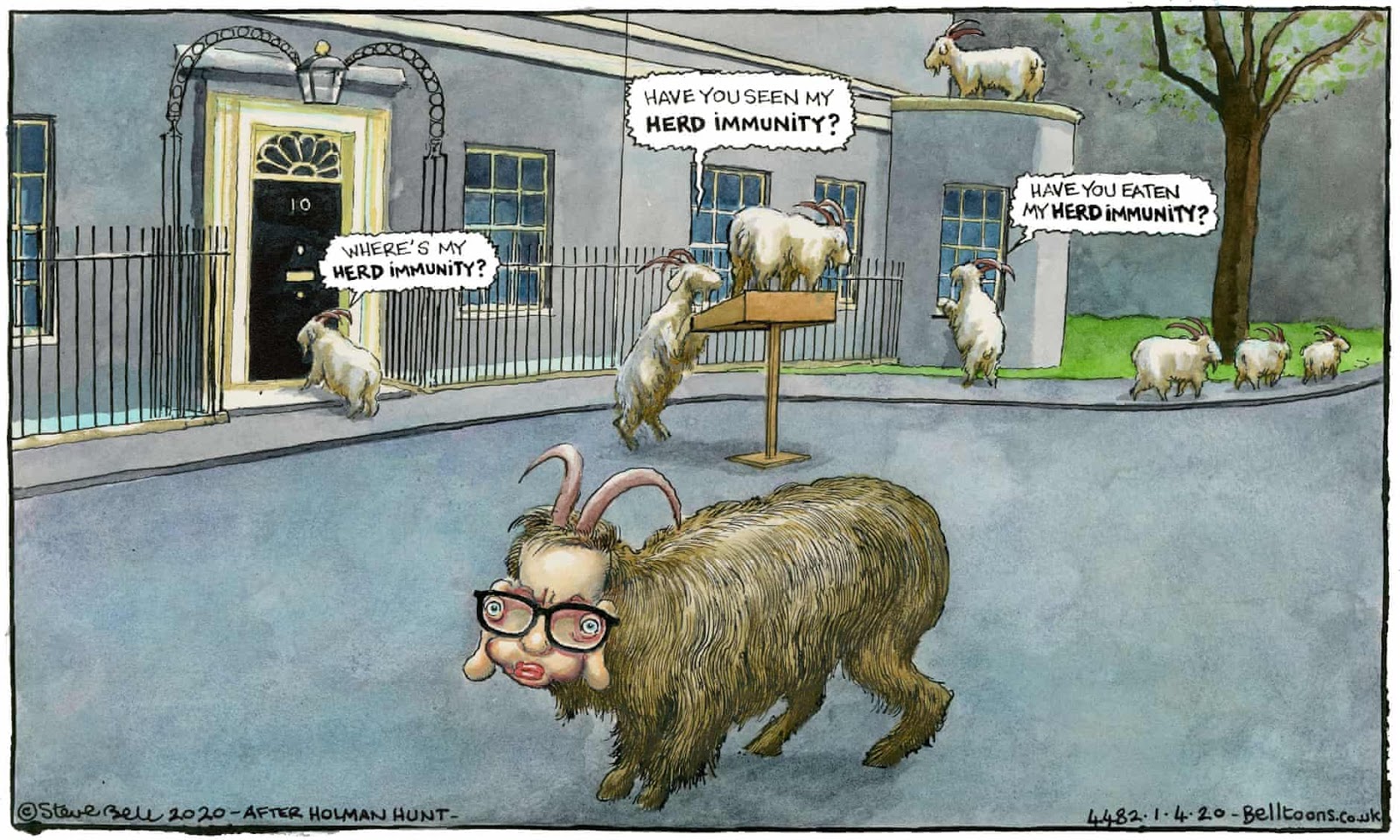
Playing The Goat


Steve Bell’s goats cartoon hits home because “herd immunity” was indeed the worst gaffe so far in the coronavirus emergency, a verbal disaster on a par with Hillary Clinton’s “basket of deplorables” which may have given us the Trump presidency and all that’s followed from that. Herd immunity is a perfectly respectable technical term in epidemiology: “ a form of indirect protection from infectious disease that occurs when a large percentage of a population has become immune to an infection, whether through previous infections or vaccination, thereby providing a measure of protection for individuals who are not immune.“

There are two huge problems with its use in this crisis. First, it contains the word “herd” which is grossly offensive when applied to human beings in a democracy, though perfectly acceptable when used in the abstract about biological systems. It has no place in any political discourse and deploying it was more or less like throwing a hand grenade into a crowded room.

The second problem is not of words but facts. The coronavirus appears to have a lethality around 1-5% of those infected (with much uncertainty until a lot more testing); a vaccine is probably 18 months away, if one can be found that works, so herd immunity will be the de facto result anyway as it is for flu and most other viral diseases. If around 80% of infections are mild or symptomless and the other 20% require hospitalisation, of whom a quarter may be critical, then a strategy based on what could perhaps better be called “community immunity” might have worked (as is being tried in Sweden). It could only ever be morally acceptable if those 20% are guaranteed plentiful and effective hospital treatment, but this was being contemplated by a government which has spent the last decade deliberately reducing the preparedness of the NHS through its policy of austerity.

But in any case it still could never have been politically acceptable in a country like today’s UK in the age of social media, where individualism and dread of such a horrible, invisible threat have largely eroded collective solidarity (already deliberately weakened by successive Conservative governments since Thatcher). Dominic Cummings and Toby Young notwithstanding, most of Johnson’s colleagues realised this – none too quickly – and performed a U-turn whose long-term political consequences are incalculable. Their mass destruction of jobs and small firms might shift us to the social-democratic Left or to the Far Right.

After 2008 the Left utterly failed to make its case for Keynesian reflation and allowed the Tories’ “household budgeting” metaphor to persuade the electorate to vote for austerity. As I write the new Labour leader has yet to be announced, but whoever it is has an even greater challenge before them. Boris Johnson is chameleon enough to take on Keynesian colouring for a while, though it remains to be seen whether he can keep his party with him. But strident Left sloganeering while the virus crisis persists is likely to be counterproductive, and working out a really cast-iron strategy for holding the Tories to account after it ends must be the priority.

Friday, 24 January 2020

There Must Be Some Way Out of Here

I've been expecting Boris Johnson to become Prime Minister ever since he was Mayor of London, and was only mildly surprised when Michael Gove's little Brutus-act delayed his progress by a couple of years. I don't possess any supernatural powers of prediction, it just seem blindingly obvious that he's the only politician with sufficient ruthlessness and charisma among the current professionalised political class. What was a bit surprising was just how inadequate they all proved at dealing with his Machiavellian skills during those grim months from October to December last year (when even the speaker of the Commons was trying to egg them on like a rowing cox).

This post is the text of a talk I gave in January to a panel discussion organised in Finsbury Park by Phil Cohen, under the name 'There Must Be Some Way Out Of Here'. The other speakers were Phil himself, Andrew Calcutt, Valerie Walkerdine, Tim (T.J.) Clark, Lynne Segal and Baroness Ruth Lister: 


Dick Pountain/There Must Be.../ 20th January 2020 08:52:01

I realised the election was lost on the Friday before, when Channel 4 News sent a team to do a vox pop in a northern labour seat. The man they interviewed, who’d only ever voted labour before, called Boris a "lovable buffoon" but said he would nevertheless vote for him. The following week’s defeat was particularly bitter because many people hoped that Labour was about to win a majority comparable to that of 1945 which founded the modern welfare state. Attlee's government came to power thanks to a social solidarity engendered by the collective experience of fighting and provisioning World War Two. British business - or “the capitalist class” if you prefer - was prepared to compromise with organised labour both for their common interest in reconstruction and to avoid the threat of more radical expropriation.

That degree of solidarity clearly can’t be relied upon nowadays, and to understand why, examine what lay behind that man’s description of the "lovable buffoon" who’s now our prime minister. He knew quite well that Boris Johnson isn't going to solve his personal economic problems, but he didn't believe Jeremy Corbyn would solve them either. That’s probably because he thinks no-one can, but he'd rather vote for the one that he thinks is more like himself -- the one who like a drink and a laugh, and who will get Brexit done -- a largely symbolic raising of the drawbridge that he thinks might preserve what he does have from marauding foreigners. The world’s going to hell in a handbasket but he'd rather go there with Boris, and with a giggle rather than a lecture.


The Left devotes a lot of thought to the question of why the working classes, both here and in the USA, choose to vote against their own "economic interests", often using abstractions like ‘false consciousness’, ‘ruling ideology’, ‘consumer capitalism’, ‘neoliberalism’, all of which are merely descriptive. For the UK we can find a more concrete answer in party politics.The 1945 welfare state improved people’s lives over the next half century enormously, in housing, healthcare, education, and employment. It once looked as if this progress would continue smoothly toward some form of pan-European social democracy.


But as we all know this progress was interrupted in 1979 by the election of a Conservative government under Margaret Thatcher, which set out to head off such an outcome. Within that government, a group on the Right of the party, who favoured an American-style unregulated economy, set out on a deliberate, tenacious and effective 40-year campaign to undo the solidarity that sustained the welfare state. During Margaret Thatcher’s three periods of office, they devised a policy of selling council houses to their occupants. In the 2nd January edition of the London Review of Books there's an excellent review by Susan Pedersen in which she identifies this policy of selling public housing as a turning point in post-war history.

The policy was part of a three-pronged attack, the other two being malicious neglect of heavy industry to weaken the grip of trade unions, and the fostering of anti-European and anti-immigrant sentiment. But the housing sales were the masterstroke. They gave many Labour voters a stake in the housing market, and this was followed up by restrictions on any further building of council houses, which eventually lead to the housing shortage and ferocious price inflation that’s still with us and is a major factor in the huge increase in inequality and homelessness of the last 40 years. It drove a wedge through the heart of Labour's support, between those who’d bought and those who hadn’t, another split that's still with us. Thatcher famously said she was creating a ‘property-owning democracy’, when in fact she only created half of one. 

The other half, now mostly at the mercy of private landlords lived more precariously, more liable to identify immigrants as competitors for jobs and homes, and less likely to vote Labour. But among the new home owners it reinforced a feeling of autonomy - having your own home to decorate as you like, perhaps a car rather than public transport to go where you like. It’s the attraction of such feelings of autonomy that’s missing from many Left analyses that ask why people vote against their ‘economic interests’ - in the last instance, they value autonomy over cash. Conflict between autonomy and collective good has been around as long as there’s been society, and it always plays better to the Right than to a Left that tends to undervalue autonomy. 

Following Thatcher’s fall, the Labour Party was forced to acquiesce in her counter reformation to get reelected in 1997 under Blair, and ever since the crash of 2007 it's been unable to regain the full confidence of ‘lovable buffoon’ man. Brexit was the Tory Atlanticist's final decisive weapon. Like all the most effective weapons it was two-edged in that it split both the main parties, but the Tory Right correctly guessed that the party’s historic will to power over principle would prevail against Labour’s historic tendency to factionalism and moral probity. And during those horrible three months of 2019 they deftly out-manoeuvered both their own “wet” wing and the Labour Party, to place Boris Johnson in power with a working majority.

Climate crisis hasn’t played a major role in the ‘Thatcherite plot’ until now, but now it’s set to widen the splits in our society that they’ve caused. And we’re not alone in this predicament, as the electorates of almost all Western democracies are splitting in a similar fashion. There’s growing generational split. The younger generations, whose futures are most threatened by climate change, are being politically galvanised by the threat, as well as by an inability to afford housing in the inflated market their parents generation profits from. There’s a growing gap between city dwellers who have decent, even greenish, public transport, and those outside cities won’t be willing to give up driving cars because alternative public transport is inadequate (and because they like driving - that autonomy thing again). Widest of all is the split between those who would close borders to keep out the mass migration of those displaced by war, flood, fire and famine, and those who support freedom of movement.

Under such conditions, promising to restore 1945-style social democracy will no longer win elections: accepting the reality of climate crisis means managing the winding down of fossil fuel usage which will be resisted, and the Right may continue to deny its reality. Australia is likely to be one of the earliest test cases, because when and if Scott Morrison’s government is thrown out over its attitude to the bush fire emergency, whichever successor that does accept the crisis will have to tackle a coal industry that provides a third of the country’s exports. In fact national solutions to the climate crisis aren’t feasible, since a degree of global governance that doesn’t exist is necessary to curb the fossil fuel industry. 
The UN is the only available institution, but its Millennium Goals, admirable as they are in principle, are unrealisable so long as climate-denying administrations like Trump’s have a power of veto.

Over the next decade preserving any sort of democracy will be a challenge, and we’ll need to invent wholly new rhetoric, institutions and practices to achieve it: the spectrum of Left, Centre and Right is no longer helpful, while electoral reform and green coalitions barely begin to touch the magnitude of the task.

Thursday, 25 July 2019

The Dude Derides

To me, a very interesting aspect of Boris Johnson’s assumption of the premiership yesterday was the fact that both the Daily Telegraph and The Independent picked up instantly on the word ‘dude’ in his acceptance speech. Both papers understood this as a reference to The Dude, hairy anti-hero of the Coen Brothers comic film ‘The Big Lebowski’, played by Jeff Bridges. The Dude has become a cult hero: ex-60s radical, sunk into alcoholism of a rather sumptuous kind (White Russian cocktails), reluctantly forced to be a makeshift private detective. Unflappably cool, partly thanks to his vodka intake, his motto is ‘The Dude Abides’.

In invoking this Bridges character Boris is making a clever appeal to a largeish proportion of the voting population who find him amusing, entertaining and unlike the typical politician. His political allegiances may be fluidly variable but this doesn’t deter this particular audience, who despise most other politicians as humourless charlatans. Boris is a humorous charlatan, and that works for many people. In short, Boris was staking a claim to be Cool, with a capital C.

In 2000 I co-authored, with my late friend David Robins, a book called ‘Cool Rules’ (Reaktion Books, Sept 2000). An informal sociological analysis of popular culture, this book was widely misunderstood as promoting the virtues of coolness, which it was not, but nor was it either condemning it. Instead the claim we made in this book is that the phenomenon we christened Cool with a capital C (hoping to avoid such confusion) is a major shift in the social psychology of affluent Western consumer societies, a change in the ‘spirit of the age’ away from Weber’s Protestant Work Ethic to a quite different constellation of character traits – which we analysed as Narcissism, Hedonism and Ironic Detachment.

The book probed the history and the consequences of this change, drawing on a wide range of reference materials, from the Beat Movement, the 1960s Counterculture, Hip Hop culture, literature and movies, the anthropology of African religions to the psychoanalysis of New York neurotics. In a nutshell we recognised Cool as an extreme form of individualism, at odds with most forms of state-based collectivism, libertarian in tendency, attracted to extremes and contemptuous of compromise and moderation. The very antithesis of Social Democracy. The final chapter of the book was about Cool Politics, and I‘ll quote a few paragraphs for the benefit of those multitudes who haven’t read it:

CHAPTER NINE - COOL RULES

In a 1998 article for the New York Review of Books Mark Lilla of the Princeton University Institute of Advanced Studies pondered the two revolutions that have transformed post-war America - the 'cultural' revolution of the 1960's and Reagan's neo-liberal economic revolution of the 1980's - and was very critical of the inadequate political responses from both the right and the left of American politics to their aftermath. He characterises their responses as 'reactionary' in the proper usage of the term: that is, the Right can only react by lambasting the moral laxity bequeathed by the '60s, while the Left reacts by railing helplessly against the triumph of Reaganomics. The facts are, as Lilla puts it, that ‘the Sixties happened, Reagan happened and for the foreseeable future they will together define our political horizon’. According to Lilla, young Americans have no difficulty in reconciling the two in their daily lives, ‘holding down day jobs in the unfettered global economy while spending weekends immersed in a moral and cultural universe shaped by the Sixties’.

These thoughts then prompted Lilla to pose a dramatic question ‘for which neither Tocqueville, nor Marx, nor Weber has prepared us: What principle in the American creed has simultaneously made possible these seemingly contradictory revolutions? How have our notions of equality and individualism been transformed to support a morally lax yet economically successful capitalist society?’ At the risk of some immodesty toward the shades of Tocqueville, Marx and Weber we offer a single word answer to Lilla: Cool.
[...]
Some might argue that Cool is primarily a western phenomenon, and that elsewhere in the world there are other equally powerful forces, for example militant Islam, that will check its progress. Another possibility is that in non-Christian cultures the Cool pose does not offer the same attraction that it does in western societies - there is, for example, no equivalent expression in the Chinese language. Actually we don't believe in any of these counter arguments. Wherever the standard of living rises to a point where television, pop music and the Hollywood movie are available (and that leaves out very few areas of the globe now) then young people will both recognise and cultivate Cool. What Cool now represents is the influence of the free market in personal relationships and sexuality, and whether politicians like it or not, probably a majority of the younger generation throughout the world now aspire to this degree of freedom. What's more, they are unlikely to be gainsaid by mere moralising, and it takes dictatorship or the military triumph of religious fundamentalism to divert them from its pursuit.
[...]
So how bad could it be if Cool did rule the world? Certainly the traditional Left would experience it as absolute defeat - capitalism unleashed and unregulated, free to seek new markets where it will. Cool consumer capitalism has discovered, as Thomas Frank puts it, how to construct ‘cultural machines that transform alienation and despair into consent.’
But the triumph of Cool would be no more comforting to those on the traditional Right since it represents the collapse of all their most cherished values. The USA, as Mark Lilla’s question makes clear, must be our model for what happens when a society embraces the free market both in labour and leisure, while losing interest in party politics: unprecedented prosperity for the many, misery for the few, Wall Street at an all-time high, jails overflowing, and a lack of any truly oppositional (as opposed to knee-jerk reactionary) politics. The maintenance of a healthy democracy requires a perceptible difference between the parties of left and right, and real confrontations over real issues, and in this light the emergence of an apolitical Cool generation is alarming.
[...]
Cool prefers the image of rebellion, as offered by glamorous terrorists, gangsters and wasted rock musicians, to the hard boring slog of real politics, and we would all do well to remember that Adolf Hitler was also a cultural rebel with artistic pretensions, a distinctive haircut, big trousers and kinky boots
[...]
Cool may once have been an expression of rebellion but it is surely not any longer. The real question is whether or not it can sustain the key elements, the rule of law and freedom of conscience, that make western democracy the least bad form of government ever invented. The picture is murky and contradictory: on the one hand Cool values personal freedom above all, it hates racism, it is egalitarian and hedonistic in temperament, on the other hand it is fascinated with violence, drugs and criminality, and mesmerised by the sight of naked power. But this book is not an effort to predict the future, rather to explain the past - to make visible the ambiguous influence of Cool in modern life precisely so that people might start to debate such matters, and more seriously weigh the pros and cons of boredom versus excitement, order versus turmoil, tolerance versus thuggery. In the end we shall, as ever, have to wait and see what happens, for deprived of Marxism’s Historic Inevitability the future’s not ours to see - Que Sera, Sera (Sly Stone’s version of course, not Doris Day’s).


If you are at all convinced by our characterisation of Cool as Narcissism+Hedonism+Ironic Detachment then it will be clear that with the ascension of Boris, the world is now largely under the sway of Cool rulers: Johnson, Putin and even Trump fit that template. I don’t ask you to believe that Xi Jinping is also Cool, but do keep an open mind - it was a bit of a shock when we learned that Mao Tse Tung was an enthusiastic orgiast after all. But my main point is please don’t confuse ‘Cool’ with good. When the spirit of an age changes, the words used to express value change with it. All young people, and quite a lot of older ones, now say ‘That’s cool!’ to mean that’s good, but that isn’t at all what we meant by Cool. Confusion arises because culture and its value system are the sea in which a people all swim and in which they can’t normally see the water: we were trying to get our snouts above the water to examine it from the outside.

So when I call Boris Cool that isn’t any sort of praise, but rather a dire warning. It makes him impervious to most of the arguments used by the Left, and perhaps even fatally attractive to young voters. Boris’s Dude-like insouciance is the perfect camouflage for the vile opinions and policies of the hard right-wingers he’s appointed to his cabinet. We know what Priti Patel thinks about the work-shyness of British workers, but Boris is a bit of a slacker himself you know, like The Dude. No-one in their right mind wants to work nowadays, rock stars and footballers are our role models, Boris is no prude, likes a larf. It’s really hard to picture Jeremy Corbyn besting Boris at PMQs.

Tuesday, 16 October 2018

The Legacy Of 1968

In my last blog post I mentioned that I was preparing to present at a conference organised by the University of East London called ‘The Legacy of 1968’ (which went ahead with great success). When preparing my contribution I looked around for material and recalled that with my late co-author David Robins I'd once written an article for the journal New Formations (Issue 39, Winter 1999-2000), which compressed the arguments of our about-to-be published book Cool Rules, into eight pages. That book, full title 'Cool Rules: Anatomy of An Attitude' was entirely devoted to analysing the attitudes of the 1968 counterculture.

I dug out that article and was pleasantly surprised by how well it still stands up. In fact there’s nothing in it that I would want to retract 19 years later, though there is one huge thing that I would wish to insert were I writing it now. That is the unexpected economic crash of 2007-8 and its profound effects throughout the world. Our argument in Cool Rules was that the attitude of Cool was becoming dominant in affluent Western societies, to a point where it was displacing that Protestant Work Ethic, which Max Weber had identified as the psychic motor of capitalism. What we didn’t tackle was the way in which Cool was perceived by those sections of the population who didn’t share this attitude, which was precisely what 2008 made very visible indeed.

The crash of 2008 resurrected class consciousness in a reaction that quickly dispelled the illusory fog of classlessness surrounding Cool culture (remember Blair and Cool Britannia?) Silicon Valley, the media industries, fashion, music, TV, film, the liberal professions, and most of all affluent youth, were the beneficiaries of this new, looser, more fun Cool Capitalism. The socially conservative, the religious, and the most precarious sectors of the working class were the losers by it – ‘left behind’ by globalisation, outsourcing, the gig economy, their family values threatened by sex, drugs and rock & roll. They made their displeasure unmistakably felt in the UK’s Brexit referendum and the election of President Trump in the USA.

You can think of those two electoral upsets as experimental evidence for the balance between cool and uncool in Western societies: in the UK the answer is 52: 48, in the US it's slightly complicated by their Electoral college but still somewhere near 50:50. I’d venture to guess similar ratios prevail in most of Europe, and perhaps further. A seemingly unbridgeable social-psychological rift runs through most of the formerly liberal democracies which threatens them with ugly transformation.

If you haven’t read Cool Rules but would like some idea of what we were talking about, I’m attaching our New Formations précis here:   Download PDF of Cool Rules


Monday, 3 September 2018

The Three Tribes of Austerity

If the 50 years following 1918 witnessed the slow and erratic ascendance of social democracy (punctuated and accelerated by WWII) then the 50 years since have witnessed its equally slow and erratic dismantling. It was eventually Keynes ‘The General Theory of Employment, Interest and Money’ rather than Kapital which provided the theoretical understanding of that ascendancy, and in my opinion James K Galbraith’s ‘The Predator State’ is the nearest we have yet to an analysis of its demise.

In his recent article ‘The Three Tribes of Austerity' (on the Project Syndicate website) Yanis Varoufakis has suggested an enhancement of Galbraith’s thesis, one that renders the picture with somewhat higher resolution, by sorting the predators into three different species. Varoufakis of course had enlisted the advice of Galbraith during his doomed spell of trying to defend the Greek economy from EU predation, and a whiff of doom is still detectable in his article.

GENGHIS TRUMP?

It can’t have escaped some of my readers that customary Left-wing analyses have become a rather poor fit with our current predicament, namel...